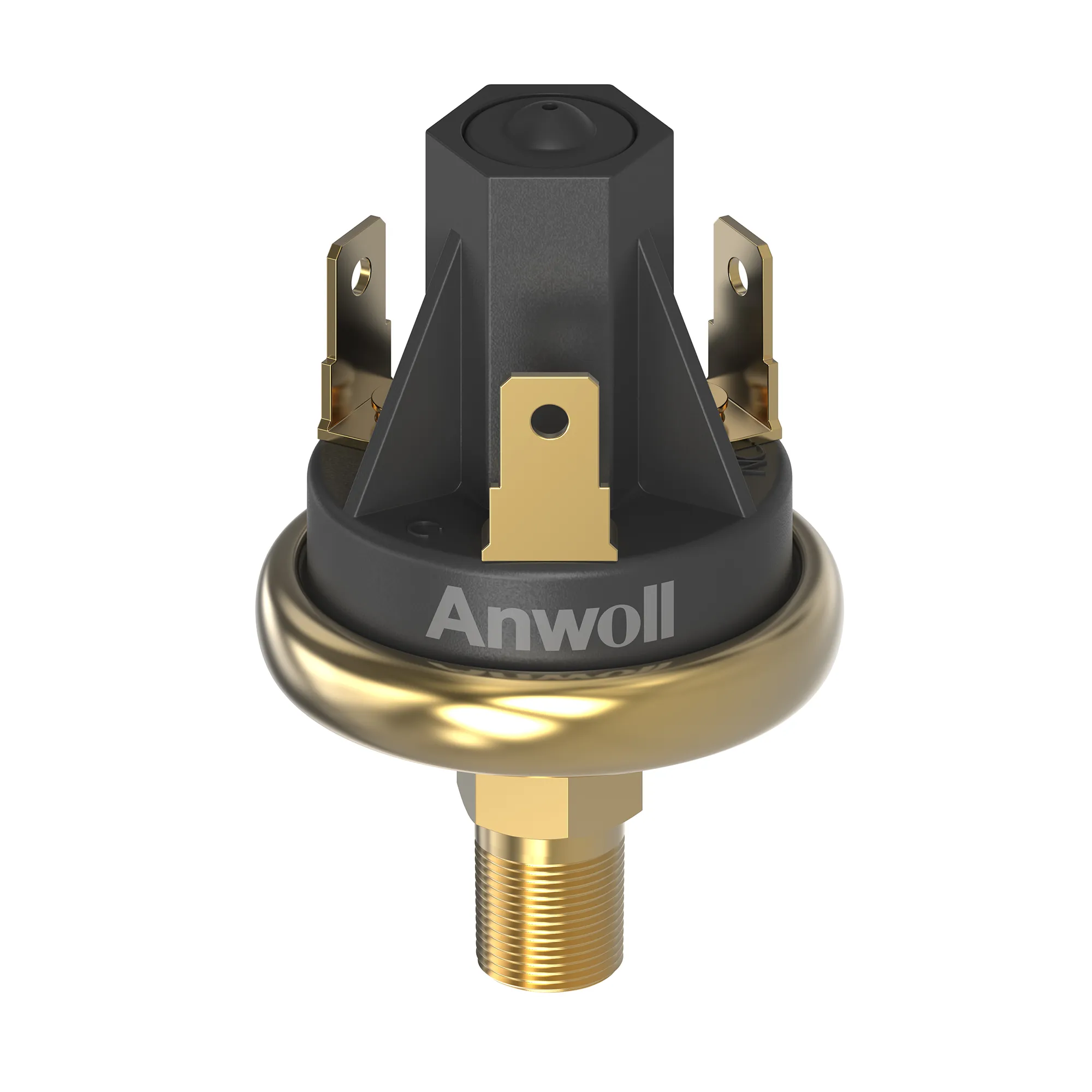
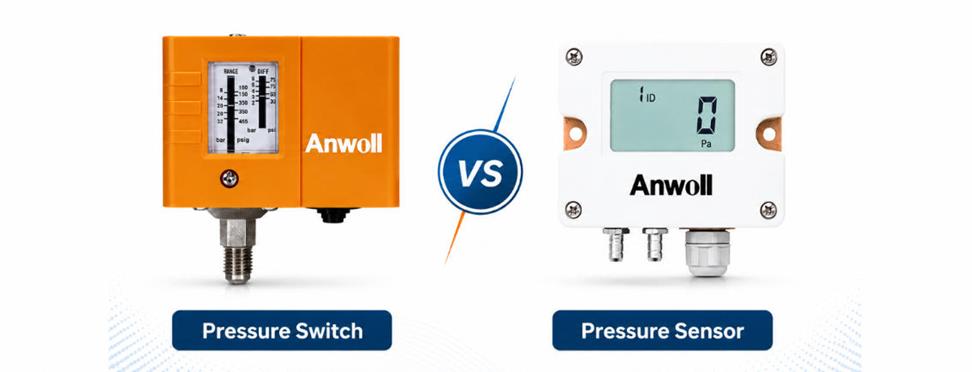
A small pressure switch operates by sensing pressure in a system and activating or deactivating an electrical contact at a preset pressure point. When the system pressure reaches the set threshold, a diaphragm or piston inside the adjustable pressure switch moves, mechanically actuating a microswitch.
This action opens or closes the circuit, sending a control signal to start or stop pumps, compressors, or alarms. Its compact design allows for easy integration in equipment where installation space is limited, while still maintaining precise pressure monitoring and control. Anwoll's small changing pressure switch combines sensitivity, stability, and space‑saving functionality.

The right pressure switch application should be defined by the measured medium, operating pressure range, switching load, installation space, and required control response before a specific model is selected.
Determine Pressure Range
Choose a range that covers your system's maximum operating pressure (e.g., 0–10 bar for general industrial use). This applies to all types of small pressure switch models, regardless of size.
Setpoint Accuracy
Select ±1% FS or higher precision for critical applications. Even in a space-saving compact pressure switch design, accuracy remains essential for reliable switching.
Process Connection
Match your pipe thread (e.g., 1/4 NPT, M12). Most mini pressure switch products offer standard threaded connections for easy installation.
Environmental Rating:
Opt for IP67/ATEX for harsh or explosive environments.
Electrical Requirements:
Confirm voltage/current ratings and contact type (SPDT/SPST) for your control system.

The terms small pressure switch, mini pressure switch, miniature pressure switch and compact pressure switch generally describe the physical size and integration requirements of the device. They do not automatically indicate its pressure range, electrical rating or compatibility with a particular medium.
Two switches with similar dimensions may have very different setpoints, contact loads, diaphragm materials and pressure connections. Equipment manufacturers should therefore select a miniature mechanical pressure switch according to the complete operating specification rather than relying only on the product’s physical size.
A micro differential pressure switch is a different product type because it compares pressure between two ports. If the application needs to monitor a filter, fan or pressure difference between two points, refer to ANWOLL's differential pressure switch range.
| Model | Setpoint Type | Pressure Set Range | Compatible Media | Main Advantage | IP Grade |
| SPS11 | Factory-calibrated fixed setpoint | 0.02–6.5 MPa | Air, water, oils, jet fuel and similar media | Broad connection and termination options | IP67 |
| SPS13 | Factory-calibrated fixed setpoint | 0.1–6.5 MPa | Air, water, oils, jet fuel and similar media | High-current switching capability | IP67 |
| SPS14 | Application-specific setpoint | 0.02–1.0 MPa | Air and water | Designed for water-purifier pressure control | IP54 |
| SPS15 | Factory set and field adjustable | 0.5–150 psi | Air, water, oils, jet fuel and similar media | Extended-duty design | / |
The best miniature pressure switch is not determined by size or pressure range alone. Buyers should also verify the required switching point, reset pressure or hysteresis, maximum system pressure, electrical load, connection, contact state and environmental protection.
For an application that requires a preset and tamper-resistant switching point, SPS11 or SPS13 may provide a suitable fixed-setpoint solution. SPS15 is more appropriate when field adjustment is required. SPS14 should be considered for water-purifier pressure-control applications.
A compact pressure switch can be integrated into hydraulic, pneumatic, lubrication and safety-control circuits where installation space is limited. Fixed-setpoint models are especially useful when equipment manufacturers need consistent switching parameters across repeated production.
SPS11 offers broad medium and connection compatibility, while SPS13 provides a higher-current option. SPS15 supports applications that require field adjustment or extended-duty operation. Explore additional pressure-control applications in industrial machinery.
Small pressure switches can provide on/off control and safety signals in refrigeration and air-conditioning equipment. A switch may be configured to interrupt equipment, activate an alarm or provide a control signal when refrigerant, air or water pressure reaches a defined limit.
SPS11 provides a compact fixed-setpoint solution with multiple connection and terminal options. SPS13 should be considered when the circuit requires a higher electrical switching capacity. The selected medium, pressure, temperature and electrical load must remain within the specification of the final model. Learn more about pressure control in refrigeration equipment.
Pressure switches in water purifiers can be used to detect inlet, operating or shutdown pressure according to the equipment design. SPS14 is specifically positioned for water-purifier applications and offers low- and high-pressure configurations across its published 0.02–1.0 MPa range.
SPS15 is designed for extended-duty applications and is listed for water pumps, pool and spa equipment. When system pressure reaches the selected setpoint, the switch can provide an electrical signal for pump control, alarm activation or equipment protection.
The switch should not be selected by pump power alone. The buyer must confirm the normal operating pressure, switch-on pressure, switch-off pressure, electrical load and maximum pressure that may occur during startup or abnormal operation. See more information about pressure monitoring for water systems.
Choose SPS13 when high-current switching is required in safety, air-conditioning or refrigeration equipment. Choose SPS15 for extended-duty uses such as water pumps, pools, spas, dental air compressors or heavy equipment; it also supports field adjustment. Confirm the setpoint, load and medium with ANWOLL.
SPS11 and SPS13 are factory-calibrated fixed-setpoint switches; SPS15 is factory set but field adjustable. Depending on the model, ANWOLL supports M, NPT, R, G, UNF or copper-pipe connections and several terminal or connector options. Send the required setpoint, thread and wiring details for confirmation and a quotation.
Choose a fixed-setpoint pressure switch when the equipment has a known operating point and requires consistent factory calibration. Choose an adjustable pressure switch when the setpoint must be changed during installation or commissioning. SPS11 and SPS13 are fixed-setpoint models, while SPS15 can be adjusted in the field.
SPS11, SPS13, SPS14 and SPS15 currently list water as a compatible medium. However, the final model must still be selected according to setpoint range, system pressure, connection, electrical load and temperature. Drinking-water approval should be confirmed separately when the switch contacts potable water.
SPS11 and SPS15 list UL, and SPS11 also gives electrical ratings for CE and CQC configurations. SPS11 and SPS13 are rated IP67; SPS14 is rated IP54. Confirm approval and protection details for the exact model and configuration before ordering.
Please provide the medium, required operating pressure, required reset pressure, maximum system pressure, operating temperature, electrical load, contact state, process connection and order quantity. These details allow ANWOLL to review the setpoint, hysteresis, material and electrical configuration before production.